
Close Menu
New York Examiner News

    Subscribe to Updates

    Get the latest creative news from FooBar about art, design and business.

    What's Hot

    Sully Erna’s Heartfelt Message After Godsmack’s Pol’and’Rock Show

    August 3, 2026

    Trump says negotiations will resume Monday afternoon while Tehran continues Hormuz talks with Oman

    August 3, 2026

    Parents Who Starved Their 75-Day-Old Baby to Death Will Get No Jail Time After Guilty Plea – Guess Who the Judge Is

    August 3, 2026
    Facebook X (Twitter) Instagram
    New York Examiner News
    • Home
    • US News
    • Politics
    • Business
    • Science
    • Technology
    • Lifestyle
    • Music
    • Television
    • Film
    • Books
    • Contact
      • About
      • Amazon Disclaimer
      • DMCA / Copyrights Disclaimer
      • Terms and Conditions
      • Privacy Policy
    New York Examiner News
    Home»Science»Risk of Dangerous Heat Exposure Is Growing Quickly in Cities
    Science

    Risk of Dangerous Heat Exposure Is Growing Quickly in Cities

    By AdminJuly 20, 2022
    Facebook Twitter Pinterest LinkedIn WhatsApp Email Reddit Telegram
    Risk of Dangerous Heat Exposure Is Growing Quickly in Cities


    Cities are famously sweltering places during heat waves, with pavement and buildings radiating heat back into the air and elevating temperatures compared to nearby rural areas. Add in global warming and an increasingly urban population, and you have a recipe for quickly ratcheting up the number of humans exposed to health-endangering heat. This exposure has tripled in recent decades—a faster rise than previous research suggested—a new study finds.

    In what the authors say is a first, the study has produced a city-by-city breakdown of how much of that increased exposure is a consequence of population growth, and how much is from physical heating (a combination of climate change and the so-called urban heat island effect). The aim, the scientists say, is to help policy makers better target strategies to protect vulnerable people. “Our study is a jumping-off point to start helping those in need,” says co-author Cascade Tuholske, a geographer at Columbia University’s Earth Institute.

    When human bodies overheat they can become dehydrated, causing the blood to thicken and forcing the heart to pump harder. That can damage it, as well as other organs. Heat is particularly a threat to those who already have health complications, such as heart disease. Very high levels of heat stress and soaring humidity can stymie the body’s natural cooling system—sweating—a disruption that can cause heat exhaustion and heat stroke. In theory, even a healthy, well-hydrated person sitting in the shade could succumb when a measurement called wet-bulb temperature, which factors in air temperature and humidity, reaches 35 degrees Celsius (95 degrees Fahrenheit).

    Previous research had suggested parts of the world would see heat waves hit that threshold later this century, as global temperatures continued to rise because of greenhouse gases released by burning fossil fuels. But a 2020 study showed some areas were already reaching it periodically. Now the new paper, published October 12 in Proceedings of the National Academy of Sciences, underscores that heat extremes are a pressing issue right now.

    The researchers examined trends in heat exposure for more than 13,000 cities from 1983 to 2016. They used a data set they say is more detailed than those used in previous studies and thus more accurately captures heat extremes. This particularly applies to places where there have historically been fewer temperature measurements on the ground, such as sub-Saharan Africa, the Middle East and South Asia.
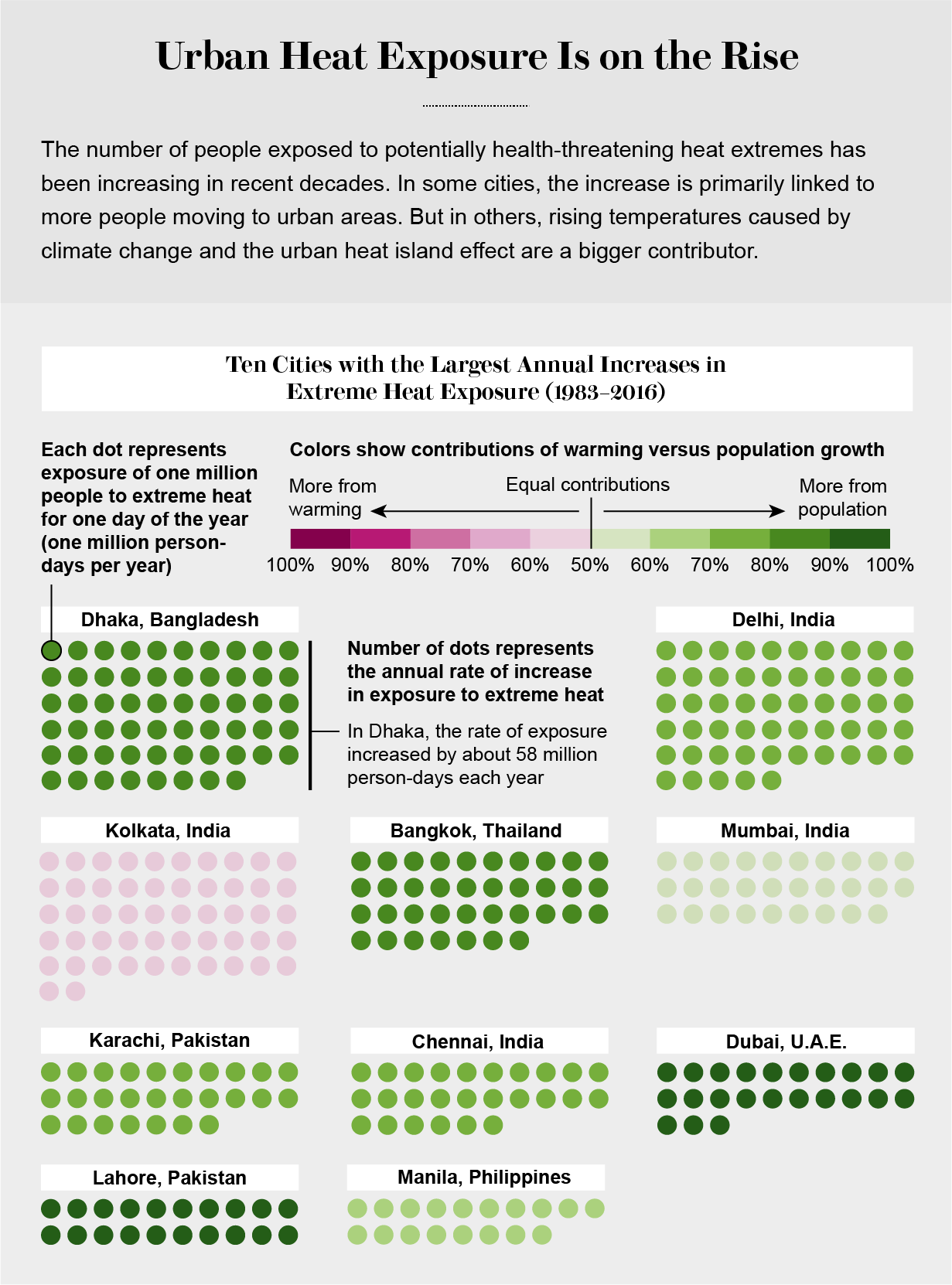
    Graphic shows key data points for 10 cities with the largest annual increases in extreme heat exposure from 1983 to 2016.


    Credit: Amanda Montañez; Source: “Global Urban Population Exposure to Extreme Heat,” by Cascade Tuholske et al., in Proceedings of the National Academy of Sciences USA, Vol. 118. Published online October 4, 2021

    Results showed that overall urban heat exposure increased by nearly 200 percent, affecting some 1.7 billion people—about a quarter of the world’s population. Physical warming accounted for about one third of the increase in the number of people exposed to hot days per year, while the rise in urban populations accounted for about two thirds.

    But how those contributions broke down varied from city to city, and from region to region. In areas where there have been major demographic shifts toward cities (such as parts of southern Asia, the Middle East and sub-Saharan Africa), population change tended to dominate the increase in exposure. In regions with slower urban growth, such as parts of Central America and the Caribbean, warming was a bigger contributor. But warming was still the dominant factor in some areas with rapid urbanization, including in the Ganges Delta and along the Nile and Tigris-Euphrates river systems. Those are areas where humid heat may be playing a particular role in driving up exposure, the study authors suggest.

    The findings show the importance of looking at specific cities instead of whole regions, the authors say. They cited the examples of Delhi and Kolkata in India; though both cities had similar increases in heat exposure, population growth was a much bigger contributor to the trend for Delhi. Knowing such differences can help focus adaptation strategies, Tuholske says.

    The global database he and his team assembled could also be useful in helping cities learn adaption strategies from one another, Tuholske says. “All of these cities are dealing with the same problem.” Kristie Ebi, who studies the health risks of climate change at the University of Washington and was not involved in the new research, echoes that thought: Having a consistent data set for so many cities “facilitates comparisons,” she says.

    The new research is “an important step towards thinking more deeply about human exposure to heat, both now and in the future,” says Jennifer Vanos, who researches heat health impacts at Arizona State University and also was not involved with the study. She cautions, though, that there are other factors to consider in designing heat health policy. Some people, for example, have readier access to air conditioning and would be less likely to suffer during intense heat waves, while those with existing health problems or who work outdoors might be more likely to become ill. Ebi says that the model could be improved in the future by including such differences in vulnerability.

    Vanos adds that the results of the study are most helpful for areas that experience both high heat and humidity, which also tend to be poorer regions of the world and ones where heat exposure is less well studied. “Policy makers should see the essential need for improving adaptive capacity and overall health in these regions,” she says, “and importantly realize that these heat issues are not future problems, but problems of today and yesterday that need sustainable solutions now.”


    Original Source Link

    Share. Facebook Twitter Pinterest LinkedIn WhatsApp Email Reddit Telegram
    Previous ArticleA teen dropout suffers for his art in the first trailer for Funny Pages
    Next Article Crypto Is Straining the Power Grid. Congress Wants to Rein It In

    RELATED POSTS

    Eating less protein could help you live longer

    August 3, 2026

    The James Webb Telescope Is Changing Astronomers’ Understanding of the Ancient Cosmos

    August 2, 2026

    AI helped produce two proofs for the same cryptography problem

    August 2, 2026

    Astronomers Have Detected an Exomoon for the First Time

    August 1, 2026

    Postpartum psychosis is at the center of the Lindsay Clancy trial. What is it?

    August 1, 2026

    The World Is Too Hot. El Niño Is Partly to Blame

    July 31, 2026
    latest posts

    Sully Erna’s Heartfelt Message After Godsmack’s Pol’and’Rock Show

    Last Thursday (July 30), Godsmack headlined the 32nd annual Pol’and’Rock Festival in Czaplinek, Poland. According…

    Trump says negotiations will resume Monday afternoon while Tehran continues Hormuz talks with Oman

    August 3, 2026

    Parents Who Starved Their 75-Day-Old Baby to Death Will Get No Jail Time After Guilty Plea – Guess Who the Judge Is

    August 3, 2026

    SummerSlam results: Roman Reigns retains the World Heavyweight Championship

    August 3, 2026

    Best Car Vacuums (2026): Handheld, Cordless, Shopping Tips

    August 3, 2026

    Eating less protein could help you live longer

    August 3, 2026

    Brand New Day’ Box Office Opening at $355M Is Second-Best

    August 3, 2026
    Categories
    • Books (1,404)
    • Business (6,308)
    • Events (64)
    • Film (6,244)
    • Lifestyle (4,319)
    • Music (6,367)
    • Politics (6,290)
    • Science (5,661)
    • Technology (6,240)
    • Television (5,934)
    • Uncategorized (9)
    • US News (6,296)
    popular posts

    The Mystery of the Colorado River’s Missing Water

    As the West continues to dry up, water managers are increasingly pressed to accurately predict…

    India’s bold GST reform expands tax base but too soon to celebrate?

    July 25, 2022

    6 Types Of Colognes – How To Make The Best Choice For 2024

    March 5, 2024

    Lindsay Lohan raises son in Dubai to escape paparazzi harassment

    August 10, 2025
    Archives
    Browse By Category
    • Books (1,404)
    • Business (6,308)
    • Events (64)
    • Film (6,244)
    • Lifestyle (4,319)
    • Music (6,367)
    • Politics (6,290)
    • Science (5,661)
    • Technology (6,240)
    • Television (5,934)
    • Uncategorized (9)
    • US News (6,296)
    About Us

    We are a creativity led international team with a digital soul. Our work is a custom built by the storytellers and strategists with a flair for exploiting the latest advancements in media and technology.

    Most of all, we stand behind our ideas and believe in creativity as the most powerful force in business.

    What makes us Different

    We care. We collaborate. We do great work. And we do it with a smile, because we’re pretty damn excited to do what we do. If you would like details on what else we can do visit out Contact page.

    Our Picks

    Eating less protein could help you live longer

    August 3, 2026

    Brand New Day’ Box Office Opening at $355M Is Second-Best

    August 3, 2026

    Gayle Rankin Loves That Alys Pisses People Off (Exclusive)

    August 3, 2026
    © 2026 New York Examiner News. All rights reserved. All articles, images, product names, logos, and brands are property of their respective owners. All company, product and service names used in this website are for identification purposes only. Use of these names, logos, and brands does not imply endorsement unless specified. By using this site, you agree to the Terms & Conditions and Privacy Policy.

    Type above and press Enter to search. Press Esc to cancel.

    We use cookies on our website to give you the most relevant experience by remembering your preferences and repeat visits. By clicking “Accept All”, you consent to the use of ALL the cookies. However, you may visit "Cookie Settings" to provide a controlled consent.
    Cookie SettingsAccept All
    Manage consent

    Privacy Overview

    This website uses cookies to improve your experience while you navigate through the website. Out of these, the cookies that are categorized as necessary are stored on your browser as they are essential for the working of basic functionalities of the website. We also use third-party cookies that help us analyze and understand how you use this website. These cookies will be stored in your browser only with your consent. You also have the option to opt-out of these cookies. But opting out of some of these cookies may affect your browsing experience.
    Necessary
    Always Enabled
    Necessary cookies are absolutely essential for the website to function properly. These cookies ensure basic functionalities and security features of the website, anonymously.
    CookieDurationDescription
    cookielawinfo-checkbox-analytics11 monthsThis cookie is set by GDPR Cookie Consent plugin. The cookie is used to store the user consent for the cookies in the category "Analytics".
    cookielawinfo-checkbox-functional11 monthsThe cookie is set by GDPR cookie consent to record the user consent for the cookies in the category "Functional".
    cookielawinfo-checkbox-necessary11 monthsThis cookie is set by GDPR Cookie Consent plugin. The cookies is used to store the user consent for the cookies in the category "Necessary".
    cookielawinfo-checkbox-others11 monthsThis cookie is set by GDPR Cookie Consent plugin. The cookie is used to store the user consent for the cookies in the category "Other.
    cookielawinfo-checkbox-performance11 monthsThis cookie is set by GDPR Cookie Consent plugin. The cookie is used to store the user consent for the cookies in the category "Performance".
    viewed_cookie_policy11 monthsThe cookie is set by the GDPR Cookie Consent plugin and is used to store whether or not user has consented to the use of cookies. It does not store any personal data.
    Functional
    Functional cookies help to perform certain functionalities like sharing the content of the website on social media platforms, collect feedbacks, and other third-party features.
    Performance
    Performance cookies are used to understand and analyze the key performance indexes of the website which helps in delivering a better user experience for the visitors.
    Analytics
    Analytical cookies are used to understand how visitors interact with the website. These cookies help provide information on metrics the number of visitors, bounce rate, traffic source, etc.
    Advertisement
    Advertisement cookies are used to provide visitors with relevant ads and marketing campaigns. These cookies track visitors across websites and collect information to provide customized ads.
    Others
    Other uncategorized cookies are those that are being analyzed and have not been classified into a category as yet.
    SAVE & ACCEPT