

Close Menu
New York Examiner News

    Subscribe to Updates

    Get the latest creative news from FooBar about art, design and business.

    What's Hot

    Ninja Warrior Replacing Horse Jumping in Olympics Modern Pentathlon

    May 27, 2026

    Sam Altman and Dario Amodei are both walking back AI jobs apocalypse predictions as they eye IPOs

    May 27, 2026

    Trump Let The Truth Slip Out While Claiming That He Is In Perfect Health

    May 27, 2026
    Facebook X (Twitter) Instagram
    New York Examiner News
    • Home
    • US News
    • Politics
    • Business
    • Science
    • Technology
    • Lifestyle
    • Music
    • Television
    • Film
    • Books
    • Contact
      • About
      • Amazon Disclaimer
      • DMCA / Copyrights Disclaimer
      • Terms and Conditions
      • Privacy Policy
    New York Examiner News
    Home»Science»These Technologies Help You Live Lightly on a Fragile Planet
    Science

    These Technologies Help You Live Lightly on a Fragile Planet

    By AdminOctober 12, 2022
    Facebook Twitter Pinterest LinkedIn WhatsApp Email Reddit Telegram
    These Technologies Help You Live Lightly on a Fragile Planet


    Carbon emissions are driving the biosphere toward a three-degree-Celsius rise in average temperature, as the Intergovernmental Panel on Climate Change (IPCC) recently noted in its Sixth Assessment Report. Intense and frequent droughts, flooding, wildfires and food insecurity are already devastating parts of the world. The usual “clean technology” solution to reduce carbon emissions has serious ecological and social costs, however.

    Renewable energy threatens to generate mountains of waste and destruction. Just replacing fossil-fuel-powered cars with fleets of electric vehicles, for example, requires vast amounts of new materials. These include critical minerals and rare-earth elements, all of which involve controversial extractive practices that damage ecosystems and people. In short, the clean-tech pathway threatens to exaggerate the exploitation of our precious living planet and fails to account for the uneven burdens felt by the poor and vulnerable, who cannot afford price hikes or the purchase of new “eco-friendly” appliances and devices. Similarly, burgeoning markets for carbon offsets (also called carbon credits) allow the wealthy to pollute at the expense of the poor, as demonstrated by the record of the United Nation’s carbon-offset program for forests.

    Instead of clean technology, what the earth and humankind need is convivial technology. The concept originated with Roman Catholic philosopher Ivan Illich, and as developed by modern thinkers such as Andrea Vetter, it includes tools and production techniques that are easily understood, created, and repaired and that assist people to fulfill their basic needs. In practice, convivial technology is used in transport, food growing, self-provisioned housing, and much more—all grounded in cooperative, mutually agreeable and sharing approaches that together comprise a convivial society.

    Such a society is integral to the realization of degrowth, which emphasizes quality of life, social and ecological values, and the modest use of materials and energy—in short, living within the earth’s limits. The IPCC report describes such approaches as “a set of measures and daily practices that avoid demand for energy, materials, land and water while delivering human wellbeing for all within planetary boundaries.” Sometimes misunderstood as depression, poverty and austerity, degrowth is really about creating socially convivial, economically secure and ecologically sustainable lives. In other words, degrowth is to growth as quality is to quantity.

    The term degrowth was coined 50 years ago, with a visible degrowth movement emerging in the new millennium. Scholarly literature on the topic, replete with policy proposals, has multiplied since 2009. The IPCC report acknowledges that the movement, “with its focus on sustainability over profitability, has the potential to speed up transformations” toward a zero-carbon or negative-carbon economy.

    So how do degrowth and convivial technology play out in practice? We can walk, ride bikes, use cargo bikes and take public transportation rather than use motorized vehicles—even electric ones. We can transform parking lots into permaculture gardens—self-sustaining ecosystems in which human activity and nature are integrated. We can plant productive trees throughout cities to diminish heat in dense urban precincts and to provide wood, fruits and nuts—all maintained by local communities. The Los Angeles Eco-Village, which will turn 30 years old in 2023, features all these initiatives and more. It covers two blocks of Los Angeles in a neighborhood of 500 people, and its members have influenced city transportation policies such as developing bike lanes.

    Cargonomia, which one of us (Liegey) co-founded in 2015, is a convivial center in Budapest that is based on three enterprises that demonstrate how degrowth works. One of these initiatives is Cyclonomia, a self-organizing do-it-yourself bicycle cooperative that operates along degrowth principles of conviviality, cooperation, mutual support and sharing. The bicycle, which is easy to build, use and repair—and is ecologically frugal—is a great example of a convivial tool. Cyclonomia helps members use its workshop to repair their own bikes. The Cyclonomia team also designs, builds and hires out bike trailers and cargo bikes to carry people and shopping and to be used as a substitute for delivery trucks.

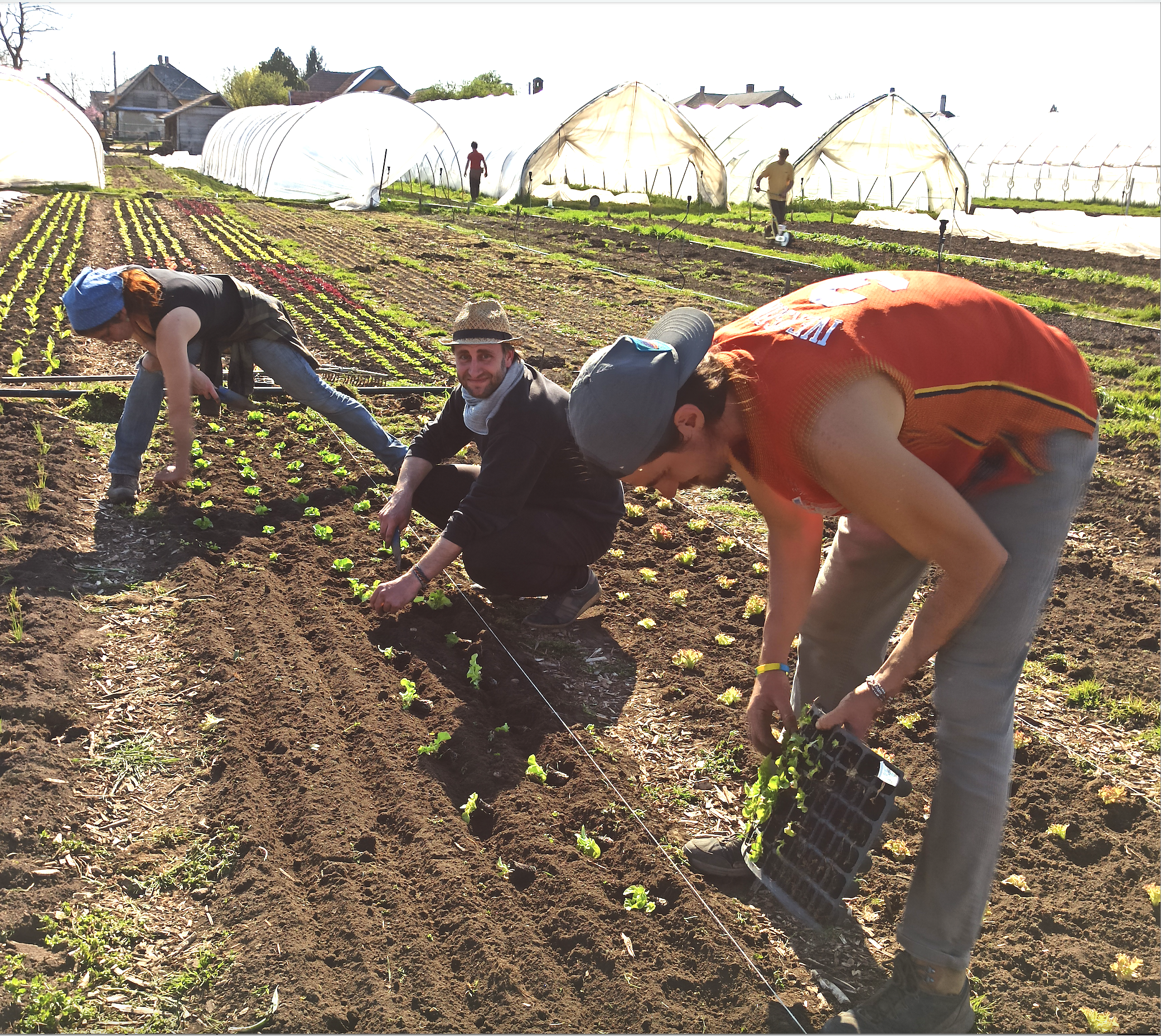
    Another linked enterprise is an organic vegetable farm and educational center for training the community in sustainable agriculture called Zsámboki Biokert. Vegetables grown at Zsámboki Biokert and neighboring partner farms are ferried to collection points in Budapest by a third self-organized Cargonomia venture called Kantaa, a bike messenger and delivery service. Budapest is far from the only city where such schemes flourish. The SHARECITY research team at Trinity College in Dublin has explored food-sharing activities in 100 cities worldwide.
    ALT
    The organic farm Zsamboki Biokert supplies fresh groceries to people in Budapest and also serves as a community training center for sustainable agriculture. Credit: Mathilde Bourdon

    When it comes to sustainability, sourcing food as close as possible to consumers is ideal. It means providing for mainly plant-based diets that are based on seasonal organic food appropriate to the local climate and soils. In convivial approaches, food consumers typically produce at least some of their food. Zsámboki Biokert offers members opportunities to work flexibly. This small farm follows principles of regenerative agriculture and permaculture, benefiting the local environment and offering greater resilience against global warming. Such farming practices, which rely on convivial tools—horses rather than tractors, for example—are especially important for improving resilience and production in food-growing areas. Recent rises in food prices, whether from COVID or from the war in Ukraine, have prompted a renewed interest in local food sources.

    Degrowth initiatives also reuse and adapt out-of-date industrial infrastructure for numerous types of artisanal work and for housing. Cargonomia occupies such repurposed buildings for its bicycle activities and is renovating a very old cottage on their farm. In urban and rural areas, degrowth housing involves building simply designed, modest dwellings with low ecological impacts by reusing local, at-hand materials while benefiting from collective work parties. Precincts of such residents develop off-grid water, sanitation and energy services. Degrowth activists campaign to refurbish and expand social housing, instead of demolishing existing structures. Similarly, degrowth advocates for more affordable, sustainable and varied housing options, such as small homes and shared, collaborative housing. Collective efforts drive the German Mietshäuser Syndikat, with nearly 200 housing projects established or underway.

    In all these kinds of ways, convivial technology helps communities achieve zero-carbon or even negative-carbon living—in contrast to clean technology, which ultimately means using more to create more. In short, degrowth and convivial technology work hand in hand to minimize extractive activities and overproduction, reducing carbon emissions at the source.


    Original Source Link

    Share. Facebook Twitter Pinterest LinkedIn WhatsApp Email Reddit Telegram
    Previous ArticleA Cooler Climate – first-look review
    Next Article Apple and Google to soon release 5G support software updates in India • TechCrunch

    RELATED POSTS

    The Cookware Industry Has a Major Fight Brewing Over PFAS Claims

    May 27, 2026

    How mathematicians use Minecraft to calculate pi

    May 26, 2026

    Does gravity create reality? A shocking path to a theory of everything

    May 26, 2026

    A Probe Took Incredible Pictures of Mars on Its Way to a Far-Off Asteroid

    May 25, 2026

    Ocean census reveals more than 1,100 new species

    May 24, 2026

    Experimental mRNA vaccine may protect against multiple Ebola viruses

    May 24, 2026
    latest posts

    Ninja Warrior Replacing Horse Jumping in Olympics Modern Pentathlon

    Out with the horses, in with the hanging hoops. A new licensing deal means athletes…

    Sam Altman and Dario Amodei are both walking back AI jobs apocalypse predictions as they eye IPOs

    May 27, 2026

    Trump Let The Truth Slip Out While Claiming That He Is In Perfect Health

    May 27, 2026

    Illegal immigrant charged in wrong-way DUI crash that killed 4 in Oklahoma

    May 27, 2026

    Pope Leo Schooled the Tech Bros on Tolkien

    May 27, 2026

    The Cookware Industry Has a Major Fight Brewing Over PFAS Claims

    May 27, 2026

    Stan Lee Documentary ‘The Final Chapter’ Lands Distribution

    May 26, 2026
    Categories
    • Books (1,267)
    • Business (6,171)
    • Events (55)
    • Film (6,108)
    • Lifestyle (4,205)
    • Music (6,226)
    • Politics (6,167)
    • Science (5,525)
    • Technology (6,104)
    • Television (5,791)
    • Uncategorized (7)
    • US News (6,159)
    popular posts

    Watch Riverdale Online: Season 7 Episode 10

    Did Jughead and Tabitha find out the truth about Ray Bradbury? On Riverdale…

    Literary Fiction: Human Stories at Their Core

    April 6, 2026

    Firms plan to use balloons to go to space in 2024

    May 13, 2022

    7 Best Glasses Cases For Men: Great Specs Protection in 2024

    April 16, 2024
    Archives
    Browse By Category
    • Books (1,267)
    • Business (6,171)
    • Events (55)
    • Film (6,108)
    • Lifestyle (4,205)
    • Music (6,226)
    • Politics (6,167)
    • Science (5,525)
    • Technology (6,104)
    • Television (5,791)
    • Uncategorized (7)
    • US News (6,159)
    About Us

    We are a creativity led international team with a digital soul. Our work is a custom built by the storytellers and strategists with a flair for exploiting the latest advancements in media and technology.

    Most of all, we stand behind our ideas and believe in creativity as the most powerful force in business.

    What makes us Different

    We care. We collaborate. We do great work. And we do it with a smile, because we’re pretty damn excited to do what we do. If you would like details on what else we can do visit out Contact page.

    Our Picks

    The Cookware Industry Has a Major Fight Brewing Over PFAS Claims

    May 27, 2026

    Stan Lee Documentary ‘The Final Chapter’ Lands Distribution

    May 26, 2026

    ‘RHOSLC’ Lisa Barlow Shares Who The Real Star Of The Show Is

    May 26, 2026
    © 2026 New York Examiner News. All rights reserved. All articles, images, product names, logos, and brands are property of their respective owners. All company, product and service names used in this website are for identification purposes only. Use of these names, logos, and brands does not imply endorsement unless specified. By using this site, you agree to the Terms & Conditions and Privacy Policy.

    Type above and press Enter to search. Press Esc to cancel.

    We use cookies on our website to give you the most relevant experience by remembering your preferences and repeat visits. By clicking “Accept All”, you consent to the use of ALL the cookies. However, you may visit "Cookie Settings" to provide a controlled consent.
    Cookie SettingsAccept All
    Manage consent

    Privacy Overview

    This website uses cookies to improve your experience while you navigate through the website. Out of these, the cookies that are categorized as necessary are stored on your browser as they are essential for the working of basic functionalities of the website. We also use third-party cookies that help us analyze and understand how you use this website. These cookies will be stored in your browser only with your consent. You also have the option to opt-out of these cookies. But opting out of some of these cookies may affect your browsing experience.
    Necessary
    Always Enabled
    Necessary cookies are absolutely essential for the website to function properly. These cookies ensure basic functionalities and security features of the website, anonymously.
    CookieDurationDescription
    cookielawinfo-checkbox-analytics11 monthsThis cookie is set by GDPR Cookie Consent plugin. The cookie is used to store the user consent for the cookies in the category "Analytics".
    cookielawinfo-checkbox-functional11 monthsThe cookie is set by GDPR cookie consent to record the user consent for the cookies in the category "Functional".
    cookielawinfo-checkbox-necessary11 monthsThis cookie is set by GDPR Cookie Consent plugin. The cookies is used to store the user consent for the cookies in the category "Necessary".
    cookielawinfo-checkbox-others11 monthsThis cookie is set by GDPR Cookie Consent plugin. The cookie is used to store the user consent for the cookies in the category "Other.
    cookielawinfo-checkbox-performance11 monthsThis cookie is set by GDPR Cookie Consent plugin. The cookie is used to store the user consent for the cookies in the category "Performance".
    viewed_cookie_policy11 monthsThe cookie is set by the GDPR Cookie Consent plugin and is used to store whether or not user has consented to the use of cookies. It does not store any personal data.
    Functional
    Functional cookies help to perform certain functionalities like sharing the content of the website on social media platforms, collect feedbacks, and other third-party features.
    Performance
    Performance cookies are used to understand and analyze the key performance indexes of the website which helps in delivering a better user experience for the visitors.
    Analytics
    Analytical cookies are used to understand how visitors interact with the website. These cookies help provide information on metrics the number of visitors, bounce rate, traffic source, etc.
    Advertisement
    Advertisement cookies are used to provide visitors with relevant ads and marketing campaigns. These cookies track visitors across websites and collect information to provide customized ads.
    Others
    Other uncategorized cookies are those that are being analyzed and have not been classified into a category as yet.
    SAVE & ACCEPT