
Close Menu
New York Examiner News

    Subscribe to Updates

    Get the latest creative news from FooBar about art, design and business.

    What's Hot

    Ministry Announce Final Album and Farewell Tour

    July 25, 2026

    On’s new technology can build running shoes in 3 minutes and eliminate 300 hours of human work

    July 25, 2026

    Trump’s Iran War Is Going To Get Republicans Blown Out In The Midterms

    July 25, 2026
    Facebook X (Twitter) Instagram
    New York Examiner News
    • Home
    • US News
    • Politics
    • Business
    • Science
    • Technology
    • Lifestyle
    • Music
    • Television
    • Film
    • Books
    • Contact
      • About
      • Amazon Disclaimer
      • DMCA / Copyrights Disclaimer
      • Terms and Conditions
      • Privacy Policy
    New York Examiner News
    Home»Science»Why Do Astronomers Seek the Most Distant Galaxies?
    Science

    Why Do Astronomers Seek the Most Distant Galaxies?

    By AdminJuly 1, 2022
    Facebook Twitter Pinterest LinkedIn WhatsApp Email Reddit Telegram
    Why Do Astronomers Seek the Most Distant Galaxies?


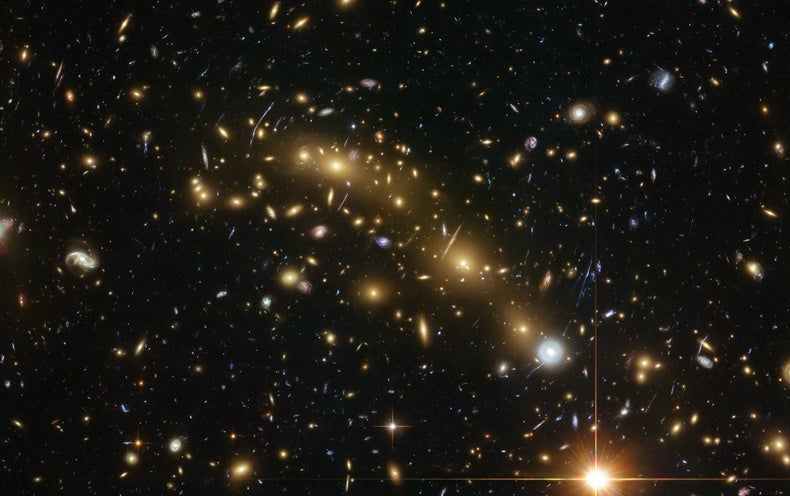
    Earlier this year, an international team of astronomers, of which I am part, presented to the world a galaxy named HD1. If confirmed, this galaxy would be the most distant astronomical object yet found.

    HD1 was shining only 320 million years after the universe’s birth in the big bang—breathtakingly close to the origin of the cosmos. The galaxy’s light made an incredible journey to reach our telescopes, one that lasted about 13.4 billion years. For perspective, dinosaurs were roaming our planet only 0.2 billion years ago, and the entire history of the Earth started 4.5 billion years ago. When the photons that would eventually be registered in our telescopes left HD1, our planet did not yet exist—the emergence of the solar system itself lay almost nine billion years in the future.

    What is the reason behind this new kind of space race to glimpse the oldest, most distant objects? There is unquestionably something poetic—epic, even—in detecting light emerging from the darkness of the primeval cosmos. But there is a much more profound motivation at work here. In simple terms, astronomers are seeking to complete a millennia-long quest to map the cosmos and its evolution. Studying ancient objects like HD1 can help fill in long-standing gaps in our knowledge, allowing us to finally see exactly how the universe transitioned from a formless expanse of churning plasma into the familiar arrangements of galaxies, stars and planets that grace the sky.

    Studying faraway sources involves understanding what astrophysical source produced their light. Our team has proposed several explanations for HD1. We argue that the light must come either from the collective shine of billions of peculiarly massive stars, or from a supermassive black hole feeding on immense quantities of gas.

    Astronomers often attempt to infer the nature of light sources billions of light-years away by studying their spectra, a word used to indicate the light we observe when split into its component colors. This can be a complicated task—like trying to understand whether a galleon on the horizon is a hostile pirate ship or an innocuous merchant vessel, aided only by old maritime binoculars and in the middle of heavy fog. In such circumstances, information about a source is inevitably incomplete, and certainty is elusive.

    The light of HD1 reveals something puzzling: a much stronger ultraviolet emission than what other galaxies closer to us in time and space exhibit. If stars mainly produce this light, they should be somewhat different from our sun, releasing more high-energy photons. Given how far back in time our view of HD1 takes us, these shining sources could be among the first population of stars formed in the universe—so-called Population III stars. Such stars, which have never been observed thus far, are thought to be heavier, larger and hotter than our sun. Alternatively, the emission from HD1 is compatible with the light we expect from a supermassive black hole as heavy as a hundred million suns. This would be about 25 times more massive than Sagittarius A*, recently imaged by the Event Horizon Telescope at the center of our own Milky Way.

    Whatever its origins, HD1’s light is a “message in a bottle” from a very distant and rather dismal past when stars and galaxies alike were relative cosmic rarities. When HD1 was shining, the universe was finally exiting what astronomers call the cosmic dark ages: a period lasting some hundred million years essentially bereft of luminous astrophysical objects. The first stars and black holes were just starting to form, filling the universe with visible light for the first time.

    This galaxy sits 100 million years farther back in time than the previous record holder, the galaxy GN-z11 discovered in 2016, and 250 million years farther still than the bronze-medal winner, the galaxy EGSY8p7 found in 2015. The distance to a galaxy is measured with an ingenious technique based on the concept of cosmological redshift, which arises from the expansion of the universe: the more distant a source is, the faster it moves away from us, and the receding velocity of these faraway galaxies shifts the wavelengths of their spectra. For example, a light bulb that emits pure violet light, if placed in a region of the cosmos roughly corresponding to a redshift of 1 as seen from Earth, would appear as deep red. By comparing the observed spectra from these galaxies with that of a source at rest, we can infer how fast the galaxies are receding from us and hence how far away they are.

    If all cosmic history is a book, the redshift acts as the page numbers, indicating when something is happening in the story. Unfortunately, not all the chapters are visible to us—the cosmic dark ages make up the bulk of the book’s missing pages. Imagine reading Shakespeare’s Hamlet and skipping some initial scenes. You would transition from someone whispering in the darkness, on the battlements of a castle in Denmark, to a prince seeing ghosts and stabbing at tapestries. What happened? This is the situation that astronomers are facing. We now possess an excellent description of how it all started: the big bang theory has successfully explained the features of our universe. Just a few numbers, called the cosmological parameters, can fully describe the universe’s initial conditions, and decades of observations have confirmed with spectacular precision that cosmic history seems to have begun with a fiery expansion from a single, still-mysterious primordial point.

    But a shadow fell across the universe as matter cooled from its early incandescence and relatively simple initial conditions advanced into intricate complexity. This is the source of the rift in cosmic history, the darkness where astronomers wander. What’s certain is that a few hundred million years after the big bang—a blink of an eye in cosmological terms—the great shadow began to lift. Enormous clouds of gas collapsed, and stars perhaps hundreds of times heavier than our sun sparked alight, beginning a photonic deluge that, over eons, illuminated the universe. In this brief cosmic period, all the protagonists of our story, including black holes and galaxies, started to peek through from behind the dark curtain of the cosmic stage. The first stars were mostly made of hydrogen and helium, the lightest elements of the periodic table, as heavier elements did not yet exist. As they shined, these stars and their subsequent kin transmuted those light elements into heavier carbon, nitrogen, oxygen and other elements crucial to the universe as we know it today. These elements, these ashes from early stars, eventually formed everything we observe around us—you and me included.

    To fully appreciate this milestone in our chronicle of cosmic history, we must fill in the missing pages surrounding it. How did the first stars, black holes and galaxies form? How big were they, how fast did they grow, and how was their evolution interconnected? How did the cosmic transition from simplicity to complexity lead to at least one world where curious creatures gaze up at the sky in wonder? Without such details from these few but fundamental chapters, our understanding of the universe and our place within it will be forever incomplete.

    This is the deepest, purest reason why astronomers are seeking sources farther and farther out. We are privileged to live in an era when telescopes of unprecedented power can aid us in this cosmic endeavor. The recently launched James Webb Space Telescope has a primary role in this search for the first glimpses of light in the cosmic dawn. Many other telescopes will also play their part, including the Roman Space Telescope and the new class of giant ground observatories.

    More than 13 billion years of cosmic evolution have led to this moment—to us. It is heartwarming and sobering to think that our actions on this small, lonely planet may ultimately be the most profound expression of the universe coming to know itself.

    This is an opinion and analysis article, and the views expressed by the author or authors are not necessarily those of Scientific American.


    Original Source Link

    Share. Facebook Twitter Pinterest LinkedIn WhatsApp Email Reddit Telegram
    Previous ArticleLouis C.K.’s ‘Fourth of July’ Premieres In New York – The Hollywood Reporter
    Next Article Open source developers urged to ditch GitHub following Copilot launch – TechCrunch

    RELATED POSTS

    How Many Electrolytes Should You Be Taking, and Can You Have Too Many?

    July 25, 2026

    SpaceX launches Starship on successful test flight

    July 25, 2026

    What Is Entropy, Really? | WIRED

    July 24, 2026

    Ancient geology could insulate Iran’s nuclear centrifuges under Pickaxe Mountain from bombing

    July 24, 2026

    The Trump Administration Wants to Change Public Engagement Rules for Polluters

    July 23, 2026

    U.S. pledges $5 billion to boost AI in government-backed scientific research

    July 23, 2026
    latest posts

    Ministry Announce Final Album and Farewell Tour

    Ministry are calling it a day. Al Jourgensen has followed through on his long-promised announcement…

    On’s new technology can build running shoes in 3 minutes and eliminate 300 hours of human work

    July 25, 2026

    Trump’s Iran War Is Going To Get Republicans Blown Out In The Midterms

    July 25, 2026

    Mike Vrabel arrives to Patriots press conference with puppy in hand as he dodges Dianna Russini question

    July 25, 2026

    One fallen power line exposed a growing AI data center problem. Here’s how to fix it.

    July 25, 2026

    How Many Electrolytes Should You Be Taking, and Can You Have Too Many?

    July 25, 2026

    Steve Rogers Isn’t The Only Character You Shouldn’t Trust In Avengers: Doomsday

    July 25, 2026
    Categories
    • Books (1,387)
    • Business (6,291)
    • Events (63)
    • Film (6,227)
    • Lifestyle (4,302)
    • Music (6,349)
    • Politics (6,272)
    • Science (5,644)
    • Technology (6,223)
    • Television (5,917)
    • Uncategorized (8)
    • US News (6,279)
    popular posts

    Oh What a Party it was for Ravishing Renaissance Woman, Tinu!! By Lorraine Silvetz

    What is the definition of a Renaissance person? They are a person with wide interests and expertise in several areas. Brooklyn born, Nigeria raised, Tinu is…

    There’s Still Time to Shop The 313 Absolute Best Prime Day Deals

    July 18, 2024

    Speeding star offers a rare glimpse of the Milky Way’s galactic centre

    March 7, 2025

    Peter Gabriel Unveils New Song “So Much”: Stream

    July 4, 2023
    Archives
    Browse By Category
    • Books (1,387)
    • Business (6,291)
    • Events (63)
    • Film (6,227)
    • Lifestyle (4,302)
    • Music (6,349)
    • Politics (6,272)
    • Science (5,644)
    • Technology (6,223)
    • Television (5,917)
    • Uncategorized (8)
    • US News (6,279)
    About Us

    We are a creativity led international team with a digital soul. Our work is a custom built by the storytellers and strategists with a flair for exploiting the latest advancements in media and technology.

    Most of all, we stand behind our ideas and believe in creativity as the most powerful force in business.

    What makes us Different

    We care. We collaborate. We do great work. And we do it with a smile, because we’re pretty damn excited to do what we do. If you would like details on what else we can do visit out Contact page.

    Our Picks

    How Many Electrolytes Should You Be Taking, and Can You Have Too Many?

    July 25, 2026

    Steve Rogers Isn’t The Only Character You Shouldn’t Trust In Avengers: Doomsday

    July 25, 2026

    Bret Michaels Rushed To Hospital For Emergency Surgery

    July 25, 2026
    © 2026 New York Examiner News. All rights reserved. All articles, images, product names, logos, and brands are property of their respective owners. All company, product and service names used in this website are for identification purposes only. Use of these names, logos, and brands does not imply endorsement unless specified. By using this site, you agree to the Terms & Conditions and Privacy Policy.

    Type above and press Enter to search. Press Esc to cancel.

    We use cookies on our website to give you the most relevant experience by remembering your preferences and repeat visits. By clicking “Accept All”, you consent to the use of ALL the cookies. However, you may visit "Cookie Settings" to provide a controlled consent.
    Cookie SettingsAccept All
    Manage consent

    Privacy Overview

    This website uses cookies to improve your experience while you navigate through the website. Out of these, the cookies that are categorized as necessary are stored on your browser as they are essential for the working of basic functionalities of the website. We also use third-party cookies that help us analyze and understand how you use this website. These cookies will be stored in your browser only with your consent. You also have the option to opt-out of these cookies. But opting out of some of these cookies may affect your browsing experience.
    Necessary
    Always Enabled
    Necessary cookies are absolutely essential for the website to function properly. These cookies ensure basic functionalities and security features of the website, anonymously.
    CookieDurationDescription
    cookielawinfo-checkbox-analytics11 monthsThis cookie is set by GDPR Cookie Consent plugin. The cookie is used to store the user consent for the cookies in the category "Analytics".
    cookielawinfo-checkbox-functional11 monthsThe cookie is set by GDPR cookie consent to record the user consent for the cookies in the category "Functional".
    cookielawinfo-checkbox-necessary11 monthsThis cookie is set by GDPR Cookie Consent plugin. The cookies is used to store the user consent for the cookies in the category "Necessary".
    cookielawinfo-checkbox-others11 monthsThis cookie is set by GDPR Cookie Consent plugin. The cookie is used to store the user consent for the cookies in the category "Other.
    cookielawinfo-checkbox-performance11 monthsThis cookie is set by GDPR Cookie Consent plugin. The cookie is used to store the user consent for the cookies in the category "Performance".
    viewed_cookie_policy11 monthsThe cookie is set by the GDPR Cookie Consent plugin and is used to store whether or not user has consented to the use of cookies. It does not store any personal data.
    Functional
    Functional cookies help to perform certain functionalities like sharing the content of the website on social media platforms, collect feedbacks, and other third-party features.
    Performance
    Performance cookies are used to understand and analyze the key performance indexes of the website which helps in delivering a better user experience for the visitors.
    Analytics
    Analytical cookies are used to understand how visitors interact with the website. These cookies help provide information on metrics the number of visitors, bounce rate, traffic source, etc.
    Advertisement
    Advertisement cookies are used to provide visitors with relevant ads and marketing campaigns. These cookies track visitors across websites and collect information to provide customized ads.
    Others
    Other uncategorized cookies are those that are being analyzed and have not been classified into a category as yet.
    SAVE & ACCEPT